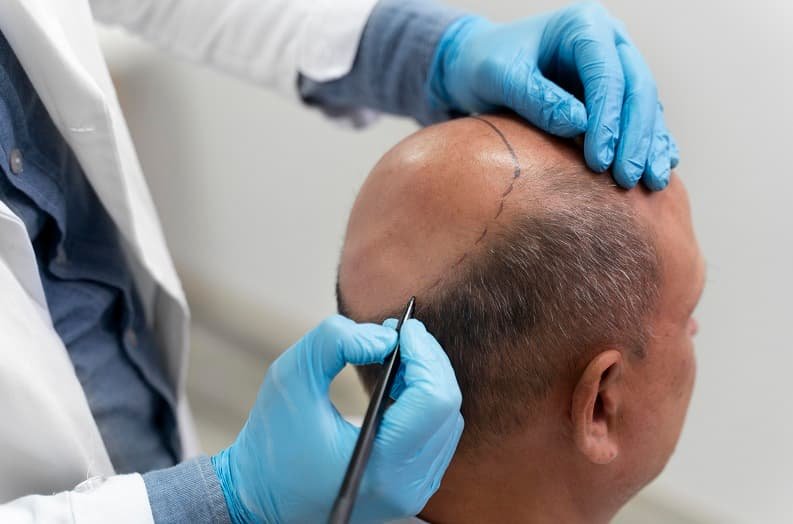
Hair transplant is one of the most popular procedures, which makes it one of the most questionable ones as well. “Is it safe for me?” “Does it have any side effects?” ” Will it be ideal to have other procedures?” Let us guide you with the procedure and help you clear doubts.
We will try to help you get a clear view of the procedure, risks, and benefits, and understand if it is right for you. Also, understand if it combines with other procedures, will it be more effective or not?
What is a Hair Transplant Procedure?
A hair transplant is a minimally invasive procedure that relocates permanent hair follicles from the back or sides of the head to thinning or balding areas.
Using local anesthesia, practitioners perform techniques like FUE or FUT to harvest grafts. The procedure ensures natural results, with final, full growth visible in 6 to 24 months. Here is more about the procedure:
- In FUE (Follicular Unit Extraction), individual hair follicles are removed directly from the scalp using a tiny punch tool.
- In FUT (Follicular Unit Transplantation), a strip of skin containing follicles is removed from the donor area, then dissected into individual grafts.
- After harvesting, the healthcare provider creates tiny, natural-angled slits in the recipient area and carefully implants the follicles.
- The procedure can take several hours, depending on the number of grafts.
Let us see the risks, side effects, and benefits of the procedure.
Riskz and Side Effects of Hair Transplant
Hair transplant procedure is generally safe, but risks include temporary hair shedding, infection, scarring, and swelling. Here are some common side effects and risks:
- Temporary shedding of transplanted and surrounding native hair (usually recovers).
- Swelling and redness are common in the scalp, forehead, and around the eyes for 2 to 3 days.
- Crusts or scabs form at the transplant sites; itching is common as the scalp heals.
- Minor, manageable infections can occur.
- Visible scars are possible, particularly with Follicular Unit Transplantation (FUT), but usually hidden by hair.
- Temporary loss of sensation (numbness) at the donor or recipient site.
Now, we will see why it is popular.
Why is Hair Transplant Popular?
Here are some of the reasons why a hair transplant is popular:
Natural and Permanent Results
The transplanted hair follicles are resistant to dihydrotestosterone (DHT), the hormone responsible for pattern baldness. This means they usually continue to grow throughout their lifetimes.
Modern techniques, such as Follicular Unit Extraction (FUE) and Follicular Unit Transplantation (FUT), involve placing healthy hair in natural, small clusters, avoiding the older, outdated methods.
Boost in Self-Confidence and Self-Esteem
It significantly enhances self-esteem and confidence by providing a permanent solution to hair loss, reversing feelings of embarrassment and social anxiety. Individuals often report feeling more youthful, attractive, and comfortable in social and professional settings after restoring their hair, directly improving their overall quality of life.
Low Maintenance
It is widely considered a low-maintenance, permanent solution for hair loss once the initial recovery period is complete. Unlike temporary solutions such as wigs, hairpieces, or topical, that require constant upkeep and recurring costs, transplanted hair behaves like natural hair.
Trusted by Many
Hair transplants are widely trusted and considered a safe and effective permanent solution for hair loss when performed by qualified professionals. They are popular due to high success rates, natural-looking results, and minimal risks. However, trust relies heavily on choosing an experienced practitioner to avoid poor results or complications.
Learn about the aftercare and results ahead.
Results and Aftercare: What to Expect
Aftercare is necessary to achieve desired results and avoid complications.
Aftercare
- Sleep on your back with your head elevated at 30 to 45 degrees for the first 5 to 7 nights to reduce swelling.
- Start gentle washing 2 days after surgery, avoiding direct shower pressure and using only the recommended shampoo.
- Avoid smoking, alcohol, and caffeine for 5 to 10 days. Avoid hats, direct sunlight, and sweating for 10 to 14 days.
- Do not pick at scabs that form around the grafts; they will fall off naturally within 7 to 14 days.
Results Timeline
- Weeks 1 to 2: Scabs form and fall off. Swelling and redness subside.
- Weeks 2 to 4: A “shock loss” phase occurs, where transplanted hair falls out. This is normal and not a sign of failure.
- Months 3 to 4: New, thin hair begins to grow.
- Months 5 to 6: Significant growth becomes visible, with hair thickening and growing stronger.
- Months 6 to 18: Final results are visible, with maximum density achieved in the crown area last.
Look for “hair transplant in Kanpur” for professional help and desired results.